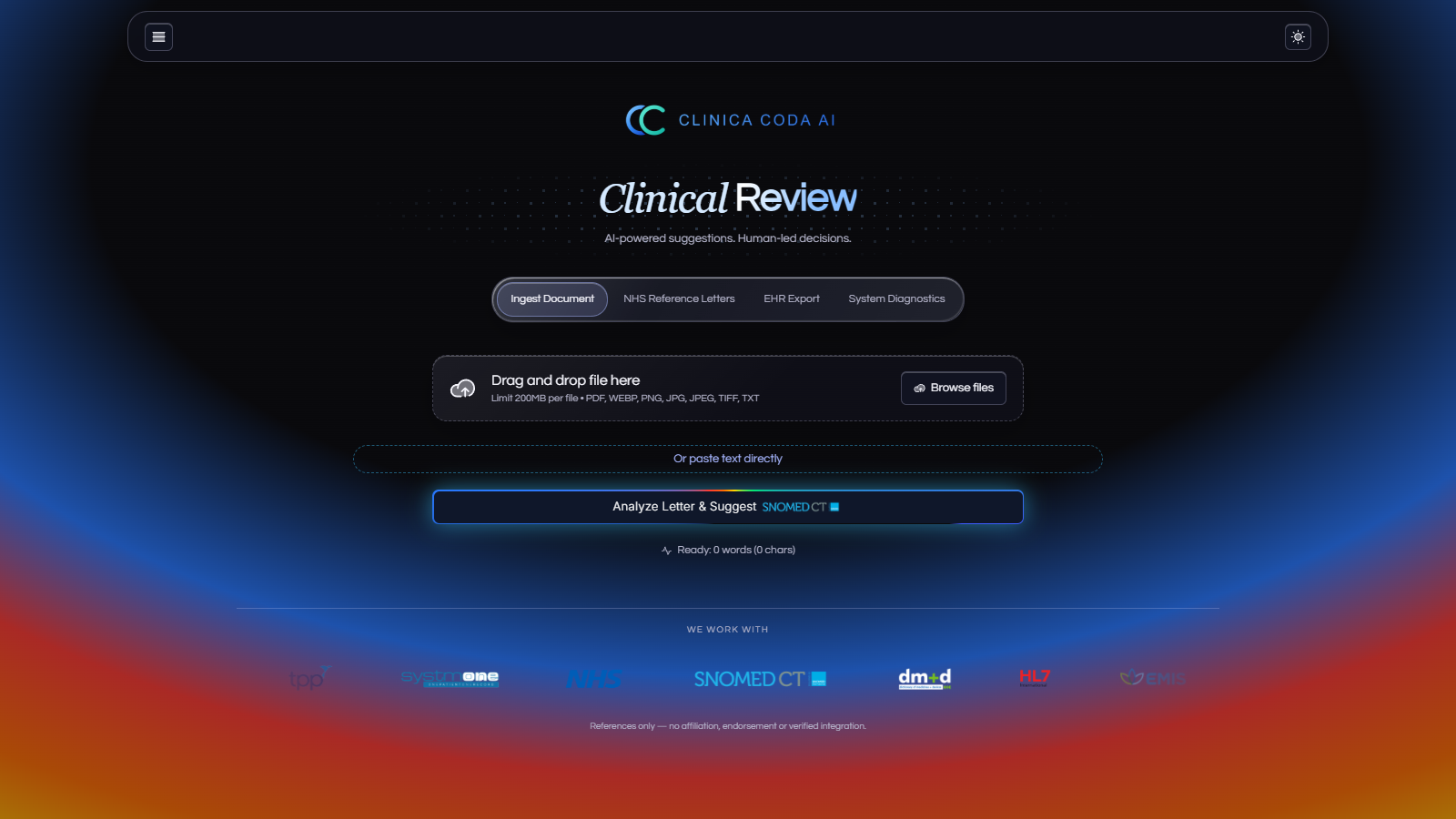
Built to reduce healthcare paperwork—starting with clinical coding in GP practices. Clinica Coda brings the letter, suggested codes and human review into one workspace.
See the product, the founder and the expansion plan.Founder-produced. Film scenarios are illustrative; later modules are planned. Current funding details appear below.
PROPOSED PRE-SEED ROUNDActively raising
£250k
A working product. The next stage of proof.
Independent validation. Practice pilots. A route to paid adoption.
Pre-pilotPre-pilot
THE WORKING APP
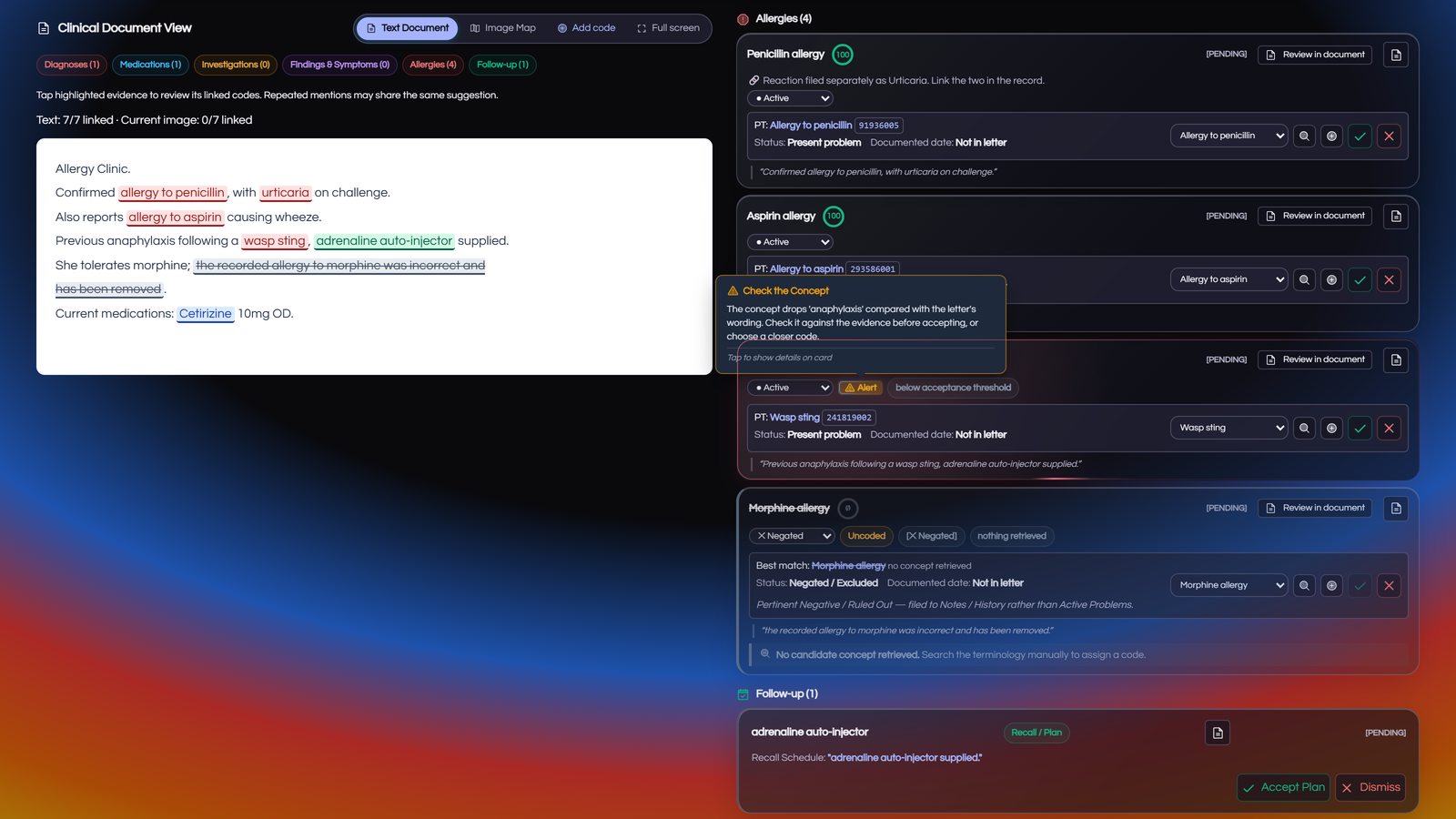
ACTUAL APP · SYNTHETIC EXAMPLE · HUMAN REVIEW REQUIRED
01 / THE PROBLEM & THE WORKING PRODUCT
The letter is only half the job.
A diagnosis to record. A medicine change to check. A follow-up to notice. One letter creates several decisions.
Clinica Coda brings the source, code suggestions and human review together. The product is built; its impact in practice is the next test.
The ambition is to carry the source and its context through more of the workflow—without losing human control.
Source letter↓Evidence + context↓Human review ✓
THE EXPANSION GATE
Prove the first step. Earn the right to scale.
Independent checks. Measured pilots. Paying practices. Each new workflow follows evidence of demand and value.
01 Validate02 Pilot03 Expand
Market ceilings and a global category forecast describe different scopes. They overlap and must not be added together. None is a revenue forecast or company valuation.
Market sources & assumptions +
The film’s UK planning base is 74,539,737 registered patients across 7,695 practices. This combines country snapshots from different dates; the Welsh patient estimate was not independently confirmed. £58.1m = that planning base × £0.065 × 12. £120.8m = the same base × the planned £0.135 full-offer price × 12. The planned 13.5p price is 6.5p for coding plus two future modules at 3.5p each. Exact calculations use 74,539,737 patients; the cards round this base to 74.54m. Both assume 100% coverage before access, competition, adoption and costs. They are indicative price-based ceilings, not validated TAM or serviceable revenue.
Grand View Research’s public medical coding report estimates $43.8bn in 2025, $48.2bn in 2026 and forecasts $96.7bn in 2033, including in-house and outsourced activity. MarketsandMarkets uses a different scope and estimates $8.91bn in 2025, reaching $14.01bn in 2030. We show the broader category estimate with its scope and year; the estimates are not directly comparable. The full paid methodologies were not reviewed.
The global figure is context for a longer-term ambition, not Clinica Coda’s current addressable market. Hospital and international coding need additional classifications, integrations, assurance and commercial validation. No hospital revenue is included in the coding-only business scenario.
Proven adjacent tools could increase revenue per practice. A validated hospital product could open a different buyer base. The round starts with the first proof point.
Expansion scope & remaining work +
NHS England identifies integration and automation opportunities across general-practice administration. UHL and UHN describe exploring AI across administration and clinical operations, including coding. These are category signals, not partnerships or endorsements of Clinica Coda.
Hospital coding uses ICD-10 and OPCS-4. The current GP SNOMED product cannot simply be relabelled. Later modules need their own demand, safety, data-protection and regulatory assessment. No valuation uplift is assumed.
External examples show activity in the category. They are not Clinica Coda partnerships, endorsements or evidence of our results.
03 / EARLY EVIDENCE
A product you can see. Evidence you can question.
SYNTHETIC DEVELOPMENT SET
106/107
Expected concepts matched.
23 synthetic letters. Our answer key. Cases reused in tuning.
Method & limitations +
Run: 9 October 2026. Also found 153/153 expected facts and correctly labelled 130/132 assertions. One concept and two context labels were wrong; handling of expected uncoded items was 31/46. This is not overall clinical accuracy.
INDEPENDENTLY MARKED PUBLIC DE-IDENTIFIED LETTERS
141/147
Marked suggestions judged right.
13 public real letters. Independently marked by a GMC-registered doctor-coder. Internal assessment, not clinical validation.
Method & limitations +
147 of 150 items marked on 12 October 2026 from a 3 October pipeline run. Three unmarked. Five wrong-code suggestions and one item that should not be filed remained. Missed facts were not measured.
Next: a second independent marker and a scoped 12-week practice pilot. Measure missed facts, review time, acceptance and cost to serve.
THE FIRST REVENUE MODEL / PROPOSED
A focused first offer. Room to expand.
6.5p
per registered patient / month
£650 monthly for a 10,000-patient practice.Pricing, targets & assumptions +
Alternative: 15.99p per letter, software only. Target 3–5 pilots, then 10–25 paying practices if evidence supports progression. At the illustrative practice size, that is £78k–£195k annual recurring revenue: a scenario, not contracted revenue or a forecast.
Pricing, support costs and integration fees remain to be tested. No GP-admin or hospital revenue is included.
04 / WHY NOW · THE £250K PRE-SEED ROUND
Why now? The window is open.
A competitor has just raised $10m and still serves about 3% of practices. The race to prove it in practice is on, and it is early.
We found no published accuracy figures from the four established suppliers. The first independent pilot, safety case and integration route will set what buyers expect.
Source: our review of supplier pages, October 2026
04
Buyers are active.
AI firms are buying UK clinical AI and GP software teams: Heidi bought AutoMedica and Doctolib bought Medicus, both this year. Examples, not a forecast or an offer.
Proposed £50k strategic first close, then £200k. The deck estimates about 12 months of lean runway. Lean first-year spend ~£177.1k. Planning assumptions, not supplier quotes.
Independent validation, live integration, clinical safety, security, data-protection arrangements and regulatory assessment remain to be established. EMIS agent simulation is not a live integration. Future modules need separate evaluation. Capital is at risk.
WHY THIS FOUNDER / WHY THIS PRODUCT
Know the work. Build around the hard parts.
A coder who has led the queue—and built the software to help work through it.
Founder experience shapes the product. Independent pilots must prove the value.See it with the founder ↗
01
Evidence you can inspect.
Check the letter, quoted wording and suggested concept together.
02
Clinical details that matter.
Review negation, stopped medicines and concepts that add or lose meaning.
03
Human control, built in.
Accept, change or reject. Only accepted items enter reviewed exports.
This is the product approach, not a claim of unique capabilities or superiority over other suppliers. Quality, time savings and willingness to pay remain pilot questions.
FOUNDER / CLINICAL FIT
Built by an NHS clinical coder.
From the coding queue to the software.
Dr Shamim Safkat Khan
Founder & CEO · MBBS · MSc Psychology of Mental Health
Lead Clinical Coder across seven GP sites. NHS coding experience. Built into the workflow.
Your details are emailed to the founder to respond to this enquiry. This website does not subscribe you to marketing or store a contact database. Please do not include patient information.