Skip to the actual product
CLINICA CODA

CLINICA CODA / PRE-PILOT

Primary care
clinical coding.
With evidence.

From clinical letters.
To clearer coding decisions.

THE STORY / IN MOTION

See it in motion.
Grasp the vision.

Evidence-linked coding. Human review. The next step.

Product walkthrough using a synthetic letter. No real patient data is used. The software has not yet been clinically validated.

SCROLL TO EXPLORE ↓

Source correspondence 01
SYNTHETIC EXAMPLE · FICTIONAL PATIENT AND CLINICIANS
Clinical correspondenceMarlowe Vale General Hospital
Station Road, Marlowe Vale
MV1 4XY
Diabetes & general medicine
Marlowe ValeUniversity HospitalsOutpatient clinic
Private & confidential
Dr S. Whitlow
Priory Road Medical Centre
Clinic date: 7 October 2026
Date typed: 8 October 2026
Our reference: DEMO / 001
Re: Anim KhanDate of birth: 14 March 1968 · Hospital no: DEMO-001

Dear Dr Whitlow,

I reviewed Anim Khan in the diabetes clinic.

Clinical review

Known type 2 diabetes mellitus. Blood pressure is stable.

Atorvastatin 40 mg at night has been stopped.

No evidence of heart failure.

Plan

Repeat blood tests before the next appointment. Please review the medication changes with Anim Khan.

Yours sincerely,
Dr Zana C
Consultant physician

Fictional hospital, clinician and patient. For demonstration only.Page 1 of 1
DiagnosisMedicationNegative finding
Linked suggestions Review
DiagnosisPending review

Type 2 diabetes mellitus

Active condition · stated in the letter

SNOMED CT44054006
Source evidence
“Known type 2 diabetes mellitus.”

The highlighted sentence supports this suggested code.

Accept Dismiss
MedicationStopped

Atorvastatin

40 mg · at night

“has been stopped”
Keep the change to treatment.
FindingNegated

Heart failure

“No evidence of heart failure.”
A negative finding, not an active diagnosis.
Ready for your review

Check each suggestion, then approve your summary.

Human decision

Illustrative app components · no live analysis or record filing

01 / READ

Before you code it.
Know what it says.

The original wording comes first.

02 / CHECK

Coding accuracy.
Check the match.

Every suggestion stays linked to its source.

03 / REVIEW

Review safeguards.
Preserve context.

Stopped. Suspected. Historical. Negated. Preserve what the letter actually says.

04 / APPROVE

AI makes suggestions.
You make the decision.

Accept, edit or dismiss. Then approve your summary.

02 / PRIVACY TEST

Privacy first.
De-identification test.

300 synthetic letters · 3,600 planted identifiers · 23 October 2026

Privacy test300 letters · De-identification

Open the folder. Select a measure.

Identifiers removed

3,600/3,600

Planted identifiers removed

Names, NHS numbers, dates of birth, postcodes, phone numbers and more were planted in 300 synthetic letters. None was left readable in the cleaned text.

Not yet tested on real letters
Method & limitations +

300 synthetic letters carrying 3,600 planted identifiers were cleaned by the local de-identification step (NHS rules plus a clinical PII model), on 23 October 2026.

Synthetic letters with planted identifiers, not real correspondence. Trust names, clinic dates, age, gender and occupation are deliberately kept. An earlier run found 54 of 1,800 identifiers left readable, all in unusual date and surname formats; the rules were fixed and this run, on a fresh seed, found none. Not a guarantee for real letters.

Cleaning happens on the practice's own machine, before anything is sent.

Identifiers removed — 3,600/3,600: Names, NHS numbers, dates of birth, postcodes, phone numbers and more were planted in 300 synthetic letters. None was left readable in the cleaned text.

Letters fully clean — 300/300: Every one of the 300 letters came back clean, including the patient's name.

Clinical wording intact — 1,861/1,861: Diagnoses, medicines and findings were checked after cleaning. None was damaged.

03 / SYNTHETIC CODING RESULTS

Coding accuracy.
Development benchmark.

23 synthetic letters · 9 October 2026

Synthetic letters23 letters · Development benchmark

Open the folder. Select a measure.

Clinical fact recall

153/153

Expected clinical facts found

Did the expected item appear in the extracted results?

Expected-item recall
Method & limitations +

23 synthetic letters tested the coding workflow. These are the recorded development results from 9 October 2026.

Cases were reused during tuning with an in-house answer key. These expected-item counts are not overall accuracy or independent validation. Expected uncoded handling was 31/46.

A suggestion still needs clinical review.

Clinical fact recall — 153/153: Did the expected item appear in the extracted results?

SNOMED concept matching — 106/107: One incorrect concept remained. The anaphylaxis example lost detail in its suggested wasp-sting concept.

Clinical context — 130/132: Active, historical, suspected and negated meanings were checked. Two assertions were incorrect.

04 / PUBLIC DE-IDENTIFIED LETTER OCR

Coding starts with reading.
A separate check.

10 public de-identified letters · Selected-line test · 1 October 2026

Public de-identified letter OCR10 documents · Selected-line experiment

Open the folder. Select a measure.

Exact-line recognition

70/77

Selected lines matched exactly

Recognition was compared with a frozen visual transcription of the selected clinical lines.

7 lines differed
Method & limitations +

The local PP-OCRv6 recognizer was tested on selected lines from 10 public de-identified letter documents new to that recognizer benchmark, on 1 October 2026. The test used very low-resolution, small-size WebP files.

Manually selected line crops, not automated whole-page recognition. An 11th new photographic example could not be localized for this line test. Earlier project use or pretraining overlap cannot be excluded. Related and previous examples are counted separately.

Reading text correctly is one part of coding.

Exact-line recognition — 70/77: Recognition was compared with a frozen visual transcription of the selected clinical lines.

Clinical field retention — 74/77: Clinical probes included names, doses, units and context wording. Exact-line and field checks ask different questions.

Negation recognition — 16/18: Two negation probes were missed. These OCR checks do not establish SNOMED mapping, medication association or clinical safety.

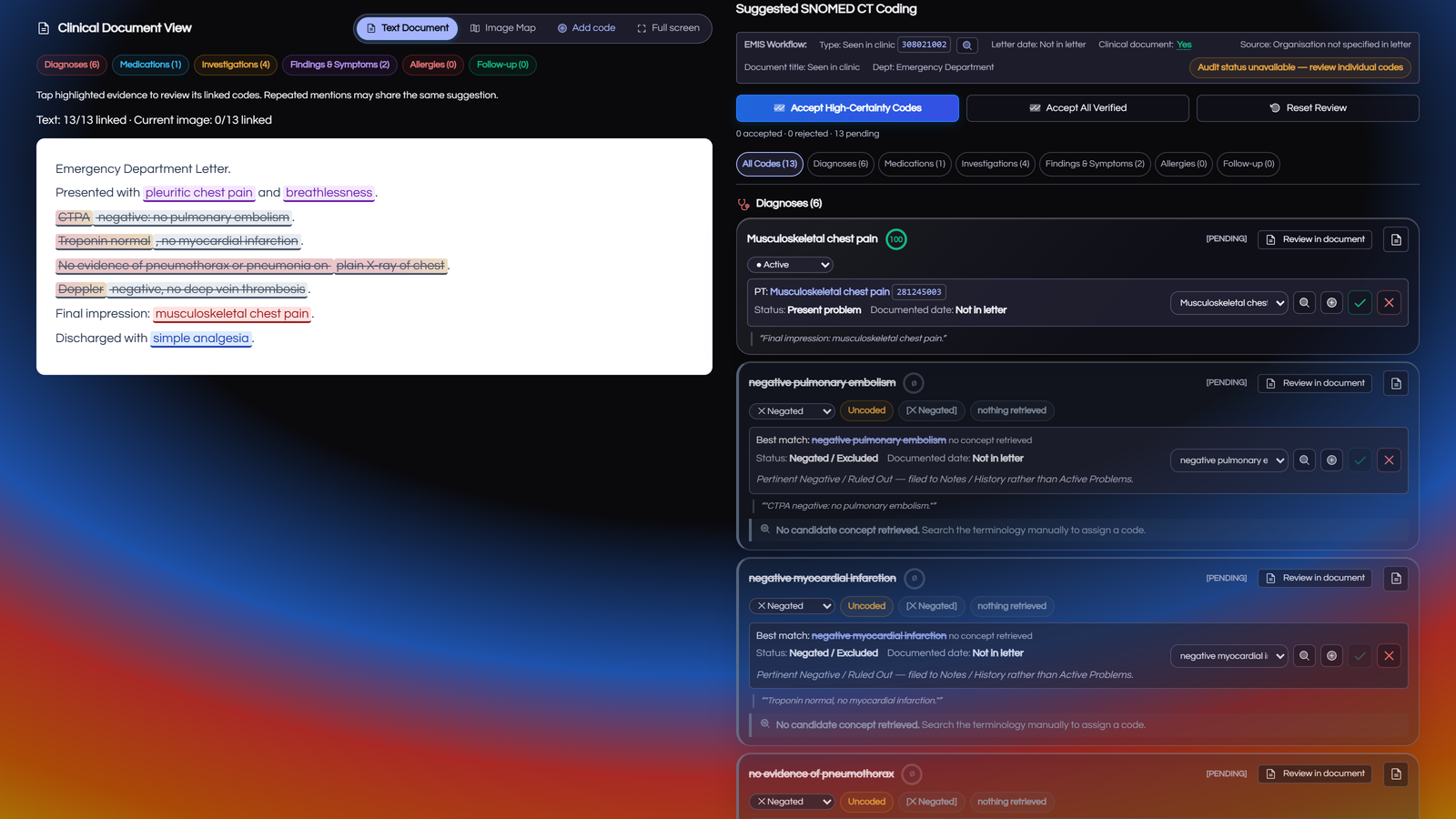
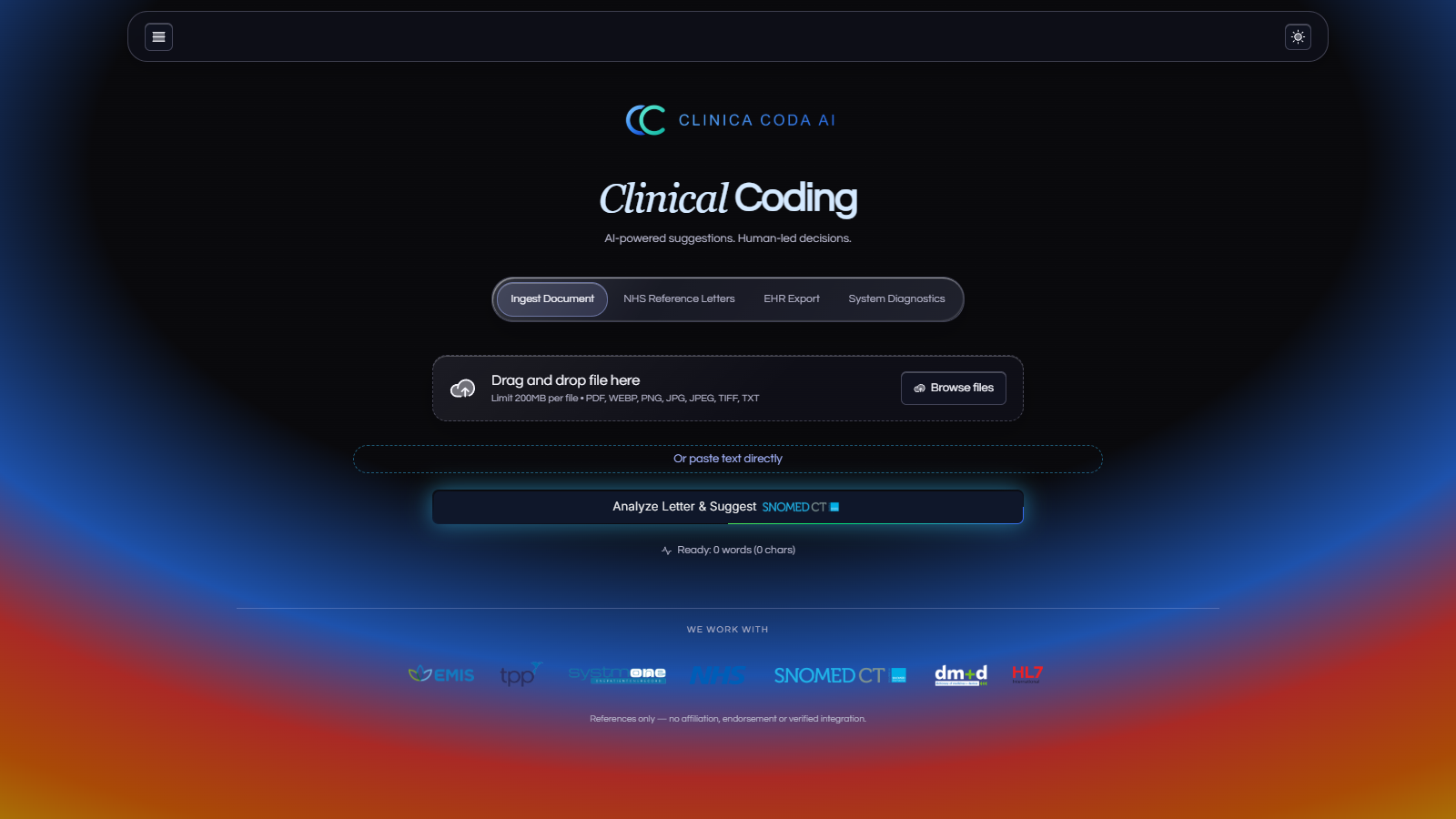
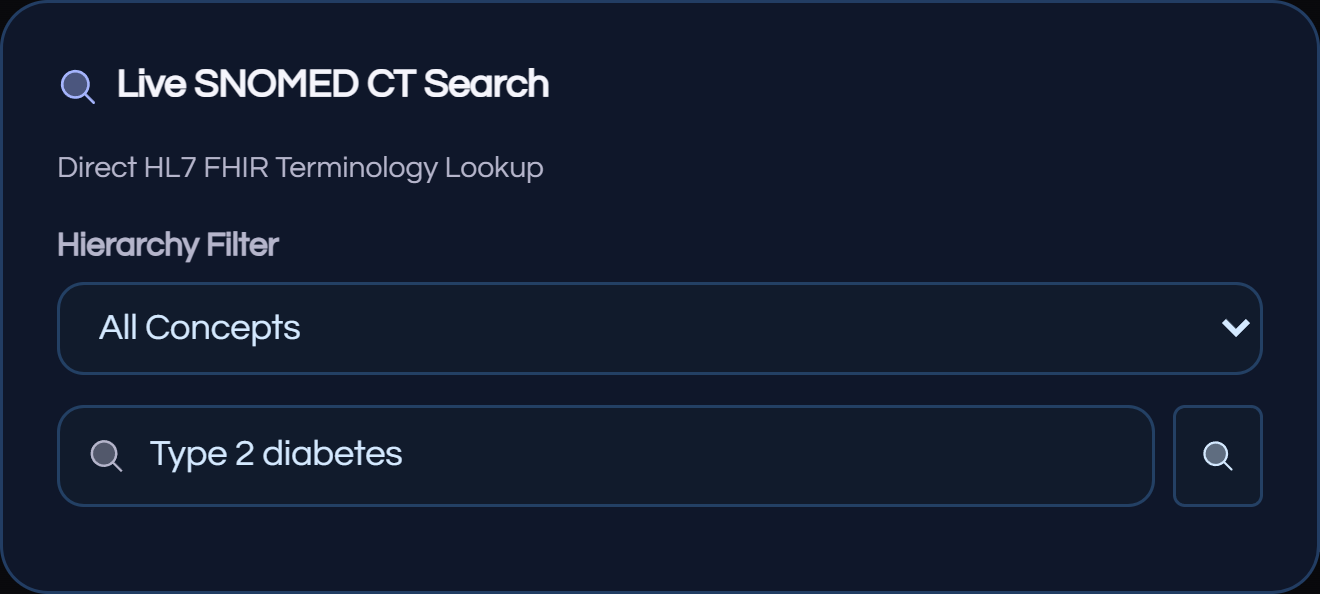
THE ACTUAL APP

Explore the real app.
See how it works.

Inside the pre-pilot productActual app · synthetic letters
Want to see it on your own letters?Request a demo ↗Ask about a practice pilot ↗

Recorded app output on synthetic cases, not a live analysis. Numeric badges are internal scores, not accuracy probabilities. QOF indicators do not establish register eligibility.

FOUNDER / CLINICAL FIT

Built by an NHS GP clinical coder.

From the coding queue to the software.

Dr Shamim Safkat Khan

Founder & CEO · MBBS · MSc Psychology of Mental Health

Lead Clinical Coder across seven GP sites. NHS coding experience. Built into the workflow.

Meet the founder ↗
GP sites
7
Trained & supported coders
15+
Clinical coding
~3 years
Software development
~7 years

Built on years of experience leading clinical coding team across multiple GP Practices in North East London.

THE NEXT CHAPTER

Measure accuracy.
Evaluate safety.

Seeking GP design partners for a scoped practice pilot.

Discuss a pilot ↗
Pilot scope

A proposed 12-week evaluation of review time, acceptance, missed facts and cost to serve. Independent validation, live EHR integration and data arrangements remain to be established.

SEE IT IN PRACTICE

See it for yourself.
Start with a demo.

See the pre-pilot product with a synthetic letter. We’ll discuss your coding workflow and whether a practice pilot is a useful next step.

Prefer email? info@clinicacoda.com

Add your organisation or a message (optional)

Your details are emailed to the founder to respond to this enquiry (UK GDPR, legitimate interests). No marketing, no contact database. Ask us any time to delete your data. Please do not include patient information.